 tuneit
Guitar essentials
Standard vs. Drop D tuning
What changes, what stays the same, and how to move between two useful six-string guitar tunings.

D–A–D–F♯–A–D Free on this page. Allow the mic and play a string.
 Get the free appScan to download on your phone
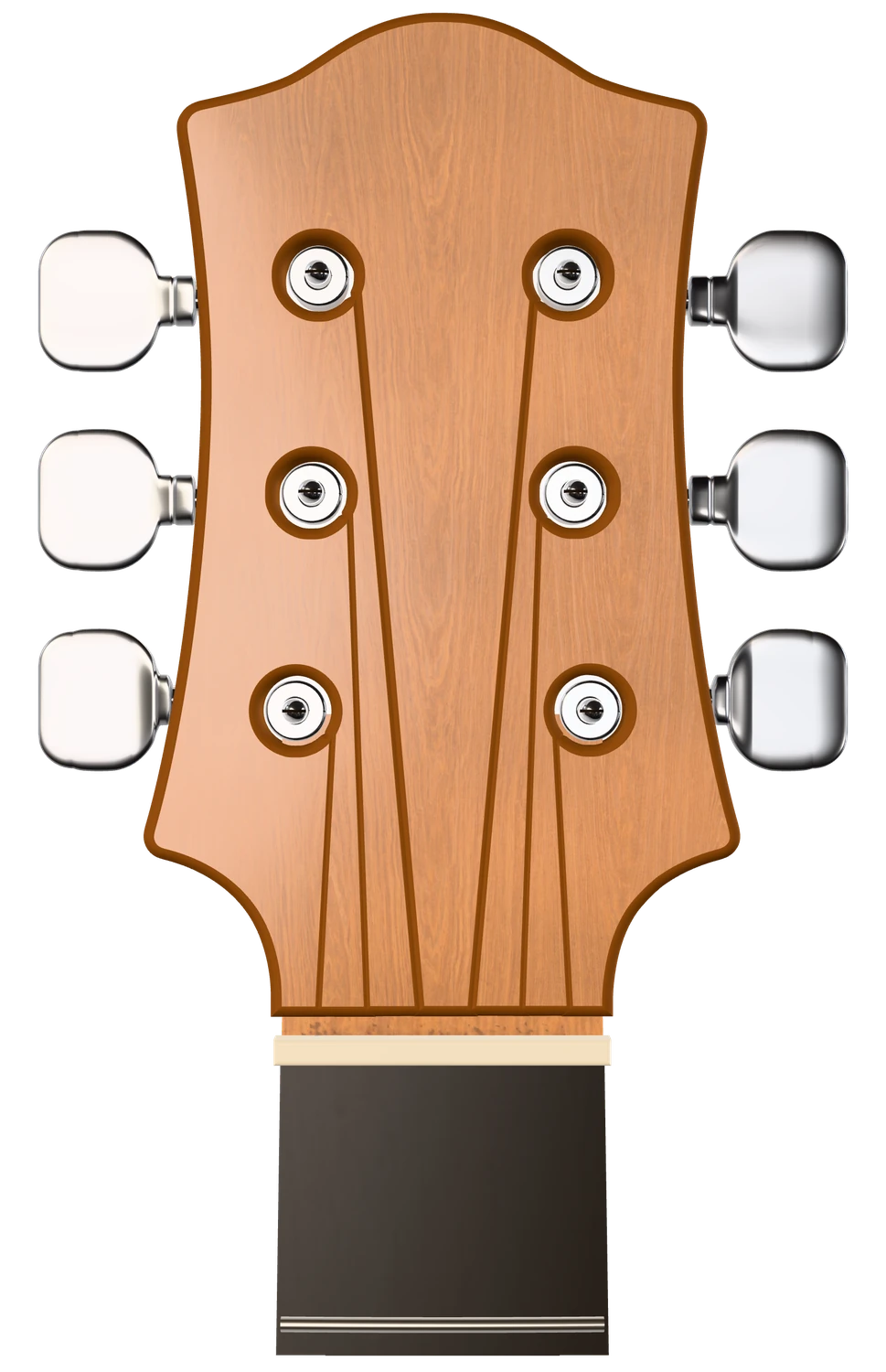







D2
The full tuner lives on your phone
Open D lowers four strings, the 6th, 3rd, 2nd and 1st, so the open guitar rings out a D major chord with the root on the lowest string.
| String | Note | Frequency | From standard |
|---|---|---|---|
| String 6 · thickest | D2 | 73.42 Hz | Down a whole step, from E |
| String 5 | A2 | 110.00 Hz | Same |
| String 4 | D3 | 146.83 Hz | Same |
| String 3 | F♯3 | 185.00 Hz | Down a half step, from G |
| String 2 | A3 | 220.00 Hz | Down a whole step, from B |
| String 1 · thinnest | D4 | 293.66 Hz | Down a whole step, from E |
Lowest string first, at A4 = 440 Hz. Highlighted strings differ from standard E–A–D–G–B–E.
From standard E–A–D–G–B–E. Turn in small steps and let each note ring before you read it.
An open D major chord with D at the bottom and top: D–A–D–F♯–A–D.
Slide guitar with the root on the 6th string, for a deeper sound than Open G.
Folk and fingerstyle, where open strings ring on under a melody. Players also call it Vestapol, an old name for the same tuning.
A quick change to Open D minor, D–A–D–F–A–D: lower the 3rd string one more half step.
Tune to Open D, then lower the 3rd string from F♯ to F. The open strings then make a D minor chord.
Only the 3rd string differs. Open D has F♯ there, which makes a major chord; DADGAD keeps it at G, which gives an open, suspended sound.
Yes. Vestapol is an old name for Open D, from a 19th-century guitar piece played in it.
Yes. Open D has its own page so you can tune to it free, with no sign-in. Switching between every tuning in one place, and the cents reading, come with Guitar Premium, the same Premium as the app.
Guitar TunerFree on iPhone and AndroidGet the app