 tuneit
Guitar essentials
Standard vs. Drop D tuning
What changes, what stays the same, and how to move between two useful six-string guitar tunings.

E♭–A♭–D♭–G♭–B♭–E♭ Free on this page. Allow the mic and play a string.
 Get the free appScan to download on your phone
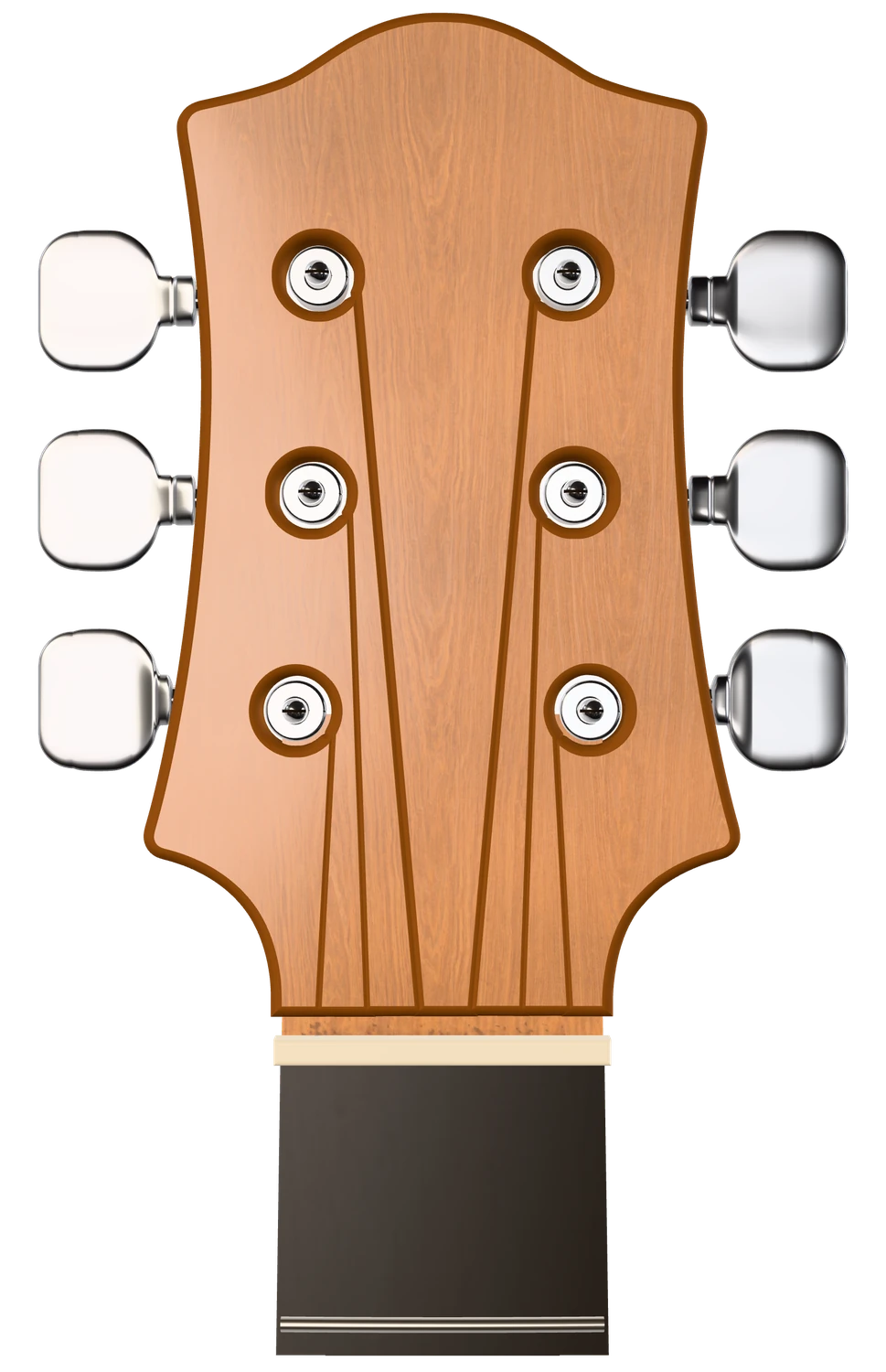







E♭2
The full tuner lives on your phone
Half step down lowers every string by a semitone. The shapes you play stay exactly the same; the whole guitar sounds a semitone lower and the strings feel a little looser.
| String | Note | Frequency | From standard |
|---|---|---|---|
| String 6 · thickest | E♭2 | 77.78 Hz | Down a half step, from E |
| String 5 | A♭2 | 103.83 Hz | Down a half step, from A |
| String 4 | D♭3 | 138.59 Hz | Down a half step, from D |
| String 3 | G♭3 | 185.00 Hz | Down a half step, from G |
| String 2 | B♭3 | 233.08 Hz | Down a half step, from B |
| String 1 · thinnest | E♭4 | 311.13 Hz | Down a half step, from E |
Lowest string first, at A4 = 440 Hz. Highlighted strings differ from standard E–A–D–G–B–E.
From standard E–A–D–G–B–E. Turn in small steps and let each note ring before you read it.
All six strings down a semitone: E♭–A♭–D♭–G♭–B♭–E♭.
Playing along with records. Jimi Hendrix, Stevie Ray Vaughan, Guns N’ Roses and Van Halen recorded much of their music tuned down a half step. In standard tuning you’d be a semitone off from start to finish.
Easier bends. Lower tension makes it easier to push a string up a whole step, one reason blues players with heavy strings tune down.
Singers. A semitone lower can take the strain off the top of a melody.
Yes. Half step down, E♭ standard and E flat tuning all mean E♭–A♭–D♭–G♭–B♭–E♭ on a 6-string guitar.
The shapes stay the same but each sounds a semitone lower, so an E shape now plays an E♭ chord and a G shape a G♭.
You don’t have to. Some players go one gauge heavier to get the old tension back, but a normal set works fine.
Yes. Half Step Down has its own page so you can tune to it free, with no sign-in. Switching between every tuning in one place, and the cents reading, come with Guitar Premium, the same Premium as the app.
Guitar TunerFree on iPhone and AndroidGet the app