 tuneit
Bass essentials
Bass guitar tuning notes: E–A–D–G explained
The four notes of a standard bass, lowest to highest, with their frequencies, string numbers, and the first frets on each string.

E♭–A♭–D♭–G♭ Free on this page. Allow the mic and play a string.
 Get the free appScan to download on your phone






E♭1
The full tuner lives on your phone
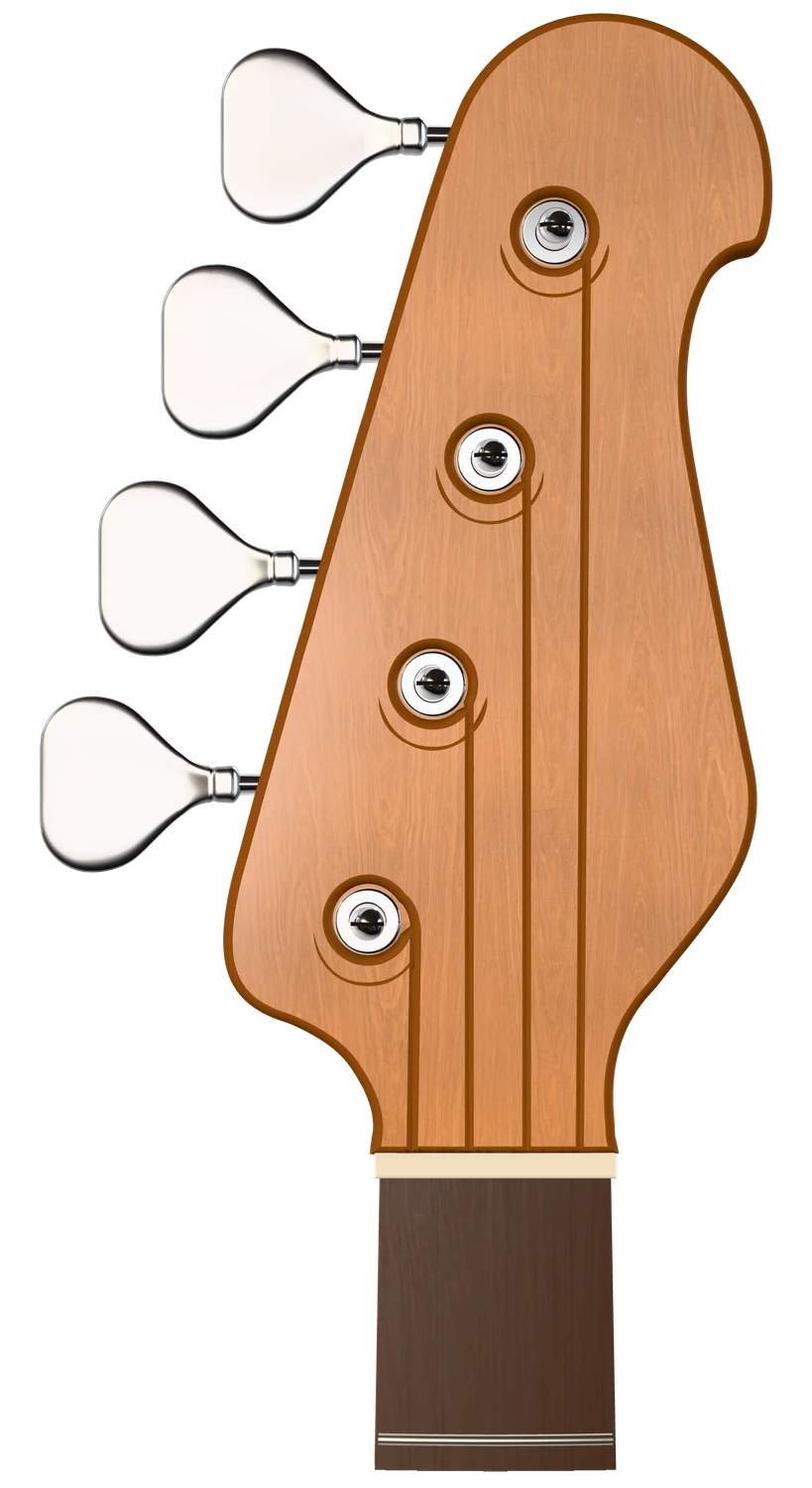
Half step down lowers all four strings by a semitone: E♭–A♭–D♭–G♭. Your shapes and fingerings don’t change at all. Everything simply sounds a semitone lower.
| String | Note | Frequency | From standard |
|---|---|---|---|
| String 4 · thickest | E♭1 | 38.89 Hz | Down a half step, from E |
| String 3 | A♭1 | 51.91 Hz | Down a half step, from A |
| String 2 | D♭2 | 69.30 Hz | Down a half step, from D |
| String 1 · thinnest | G♭2 | 92.50 Hz | Down a half step, from G |
Lowest string first, at A4 = 440 Hz. Highlighted strings differ from standard E–A–D–G.
From standard E–A–D–G. Turn in small steps and let each note ring before you read it.
Every string down a semitone, to play with bands and records in E♭.
Playing along with records made in E♭ tuning. Jimi Hendrix, Stevie Ray Vaughan and Guns N’ Roses tuned their guitars down a half step on many recordings, and when the guitars are down, the bass has to be too. In standard tuning you would be a semitone sharp the whole way through.
Singers. A semitone lower takes a little strain off the top of a vocal line, and nobody has to relearn a part.
A slightly looser feel under the fingers, from the lower string tension.
Yes. Half step down, E♭ tuning and E flat standard all mean E♭–A♭–D♭–G♭ on a 4-string bass.
No. Lower tension is easier on the neck, not harder. If you stay there for weeks and the strings start to buzz, the neck may want a small truss-rod adjustment.
E♭1 is 38.89 Hz, with A4 at 440 Hz.
Yes. Half Step Down has its own page so you can tune to it free, with no sign-in. Switching between every tuning in one place, and the cents reading, come with Bass Premium, the same Premium as the app.
Bass TunerFree on iPhone and AndroidGet the app