 tuneit
Bass essentials
Bass guitar tuning notes: E–A–D–G explained
The four notes of a standard bass, lowest to highest, with their frequencies, string numbers, and the first frets on each string.

D–A–D–G Free on this page. Allow the mic and play a string.
 Get the free appScan to download on your phone




D1
The full tuner lives on your phone
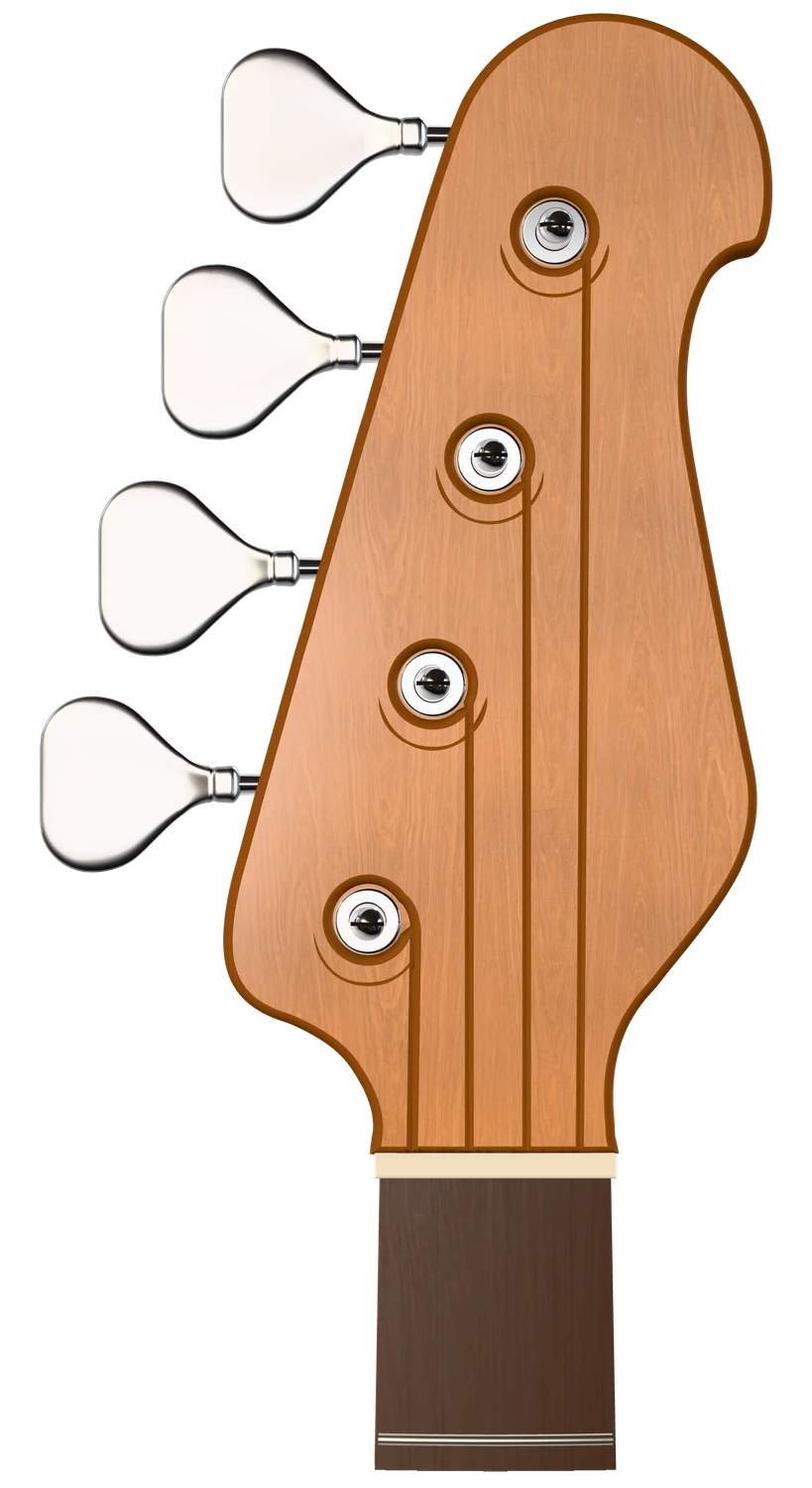
Drop D lowers only the 4th string, from E to D. The A, D and G strings stay where they are, so everything you know above the low string still works, and the bottom of the bass gains two notes: D and E♭.
| String | Note | Frequency | From standard |
|---|---|---|---|
| String 4 · thickest | D1 | 36.71 Hz | Down a whole step, from E |
| String 3 | A1 | 55.00 Hz | Same |
| String 2 | D2 | 73.42 Hz | Same |
| String 1 · thinnest | G2 | 98.00 Hz | Same |
Lowest string first, at A4 = 440 Hz. Highlighted strings differ from standard E–A–D–G.
From standard E–A–D–G. Turn in small steps and let each note ring before you read it.
Low E down to D for a deeper root and one-finger power chords.
Songs in D or D minor. The open 4th string gives you the lowest root in the key, with the open D string an octave above it.
Heavy rock, metal and grunge, to follow guitarists in Drop D (D–A–D–G–B–E). The bottom three bass strings, D–A–D, match the guitar’s an octave lower, so riffs line up note for note.
One-finger power chords. The 4th and 3rd strings are now a fifth apart, D and A, so a single finger across both at the same fret plays root and fifth.
No. A whole step down on one string works with a normal set. If the low D feels floppy or buzzes, a slightly heavier 4th string or a touch more action helps.
D1, at 36.71 Hz. Standard tuning bottoms out at E1, 41.20 Hz.
Same idea, same letters at the bottom: the lowest string drops from E to D. On bass the notes are an octave lower, and only one of the four strings changes.
Yes. Drop D has its own page so you can tune to it free, with no sign-in. Switching between every tuning in one place, and the cents reading, come with Bass Premium, the same Premium as the app.
Bass TunerFree on iPhone and AndroidGet the app