 tuneit
Guitar essentials
Standard vs. Drop D tuning
What changes, what stays the same, and how to move between two useful six-string guitar tunings.

A–E–A–D–G–B–E Free on this page. Allow the mic and play a string.
 Get the free appScan to download on your phone
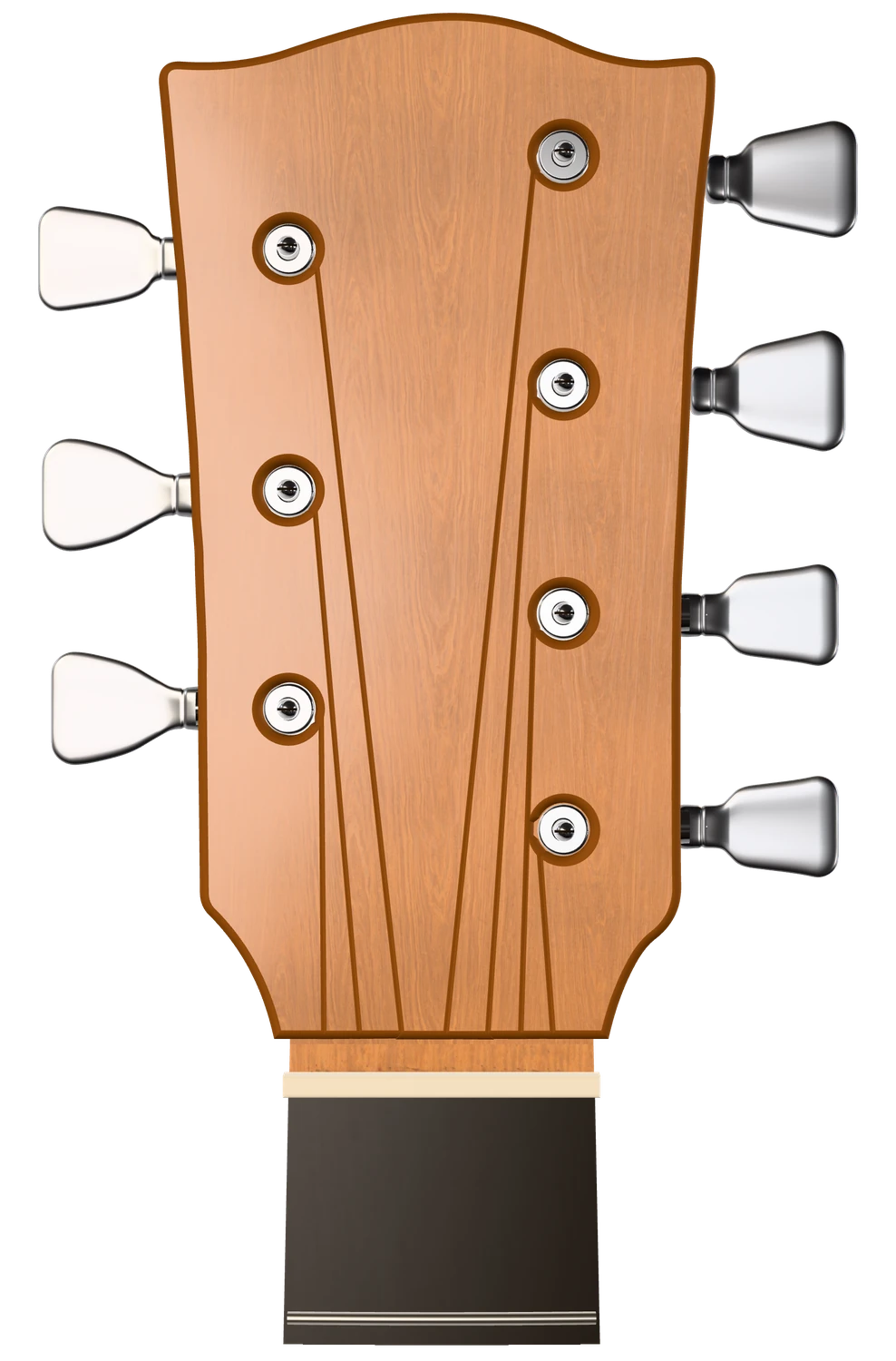












A1
The full tuner lives on your phone
Drop A lowers the 7th string from B to A. The six strings above stay in standard tuning, so everything you play on a 6-string still works, with a low A underneath.
| String | Note | Frequency | From standard |
|---|---|---|---|
| String 7 · thickest | A1 | 55.00 Hz | Down a whole step, from B |
| String 6 | E2 | 82.41 Hz | Same |
| String 5 | A2 | 110.00 Hz | Same |
| String 4 | D3 | 146.83 Hz | Same |
| String 3 | G3 | 196.00 Hz | Same |
| String 2 | B3 | 246.94 Hz | Same |
| String 1 · thinnest | E4 | 329.63 Hz | Same |
Lowest string first, at A4 = 440 Hz. Highlighted strings differ from standard B–E–A–D–G–B–E.
From standard B–E–A–D–G–B–E. Turn in small steps and let each note ring before you read it.
Low B down a whole step to A: A–E–A–D–G–B–E.
Modern metal and djent. The two lowest strings are now a fifth apart, A and E, so one finger plays a power chord.
Lining up with a 5-string bass in Drop A. The bass’s strings match the guitar’s lowest five, an octave down.
Drop A changes only the 7th string (A–E–A–D–G–B–E). A standard lowers all seven strings a whole step (A–D–G–C–F–A–D).
Only a baritone, or with very heavy strings. On a normal 6-string the low E would have to drop a fifth, far too slack.
A1, at 55 Hz: the same note as the open A string on a bass.
Yes. Drop A has its own page so you can tune to it free, with no sign-in. Switching between every tuning in one place, and the cents reading, come with 7 String Guitar Premium, the same Premium as the app.
7 String Guitar TunerFree on iPhone and AndroidGet the app