 tuneit
Bass essentials
How to tune a 5-string bass
Start with B–E–A–D–G, get a steadier low B reading, and make your next tuning session easier.

D–A–D–G–C Free on this page. Allow the mic and play a string.
 Get the free appScan to download on your phone





D1
The full tuner lives on your phone
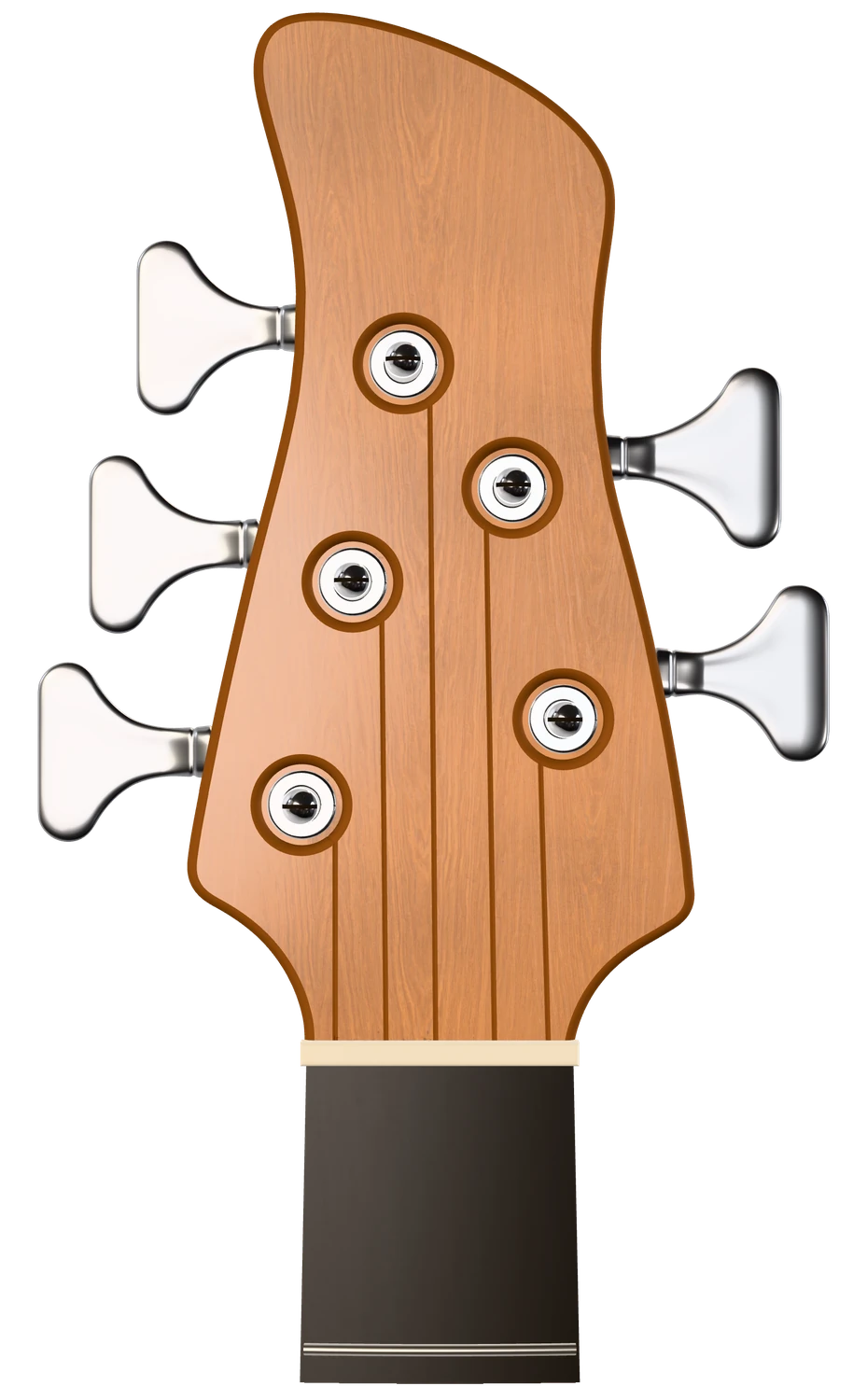
DADGC is a 5-string tuning with a high C on top instead of a low B at the bottom. Think of it as a 4-string in Drop D with one more string above the G: D–A–D–G–C.
| String | Note | Frequency | From E–A–D–G–C |
|---|---|---|---|
| String 5 · thickest | D1 | 36.71 Hz | Down a whole step, from E |
| String 4 | A1 | 55.00 Hz | Same |
| String 3 | D2 | 73.42 Hz | Same |
| String 2 | G2 | 98.00 Hz | Same |
| String 1 · thinnest | C3 | 130.81 Hz | Same |
Lowest string first, at A4 = 440 Hz. Highlighted strings differ from E–A–D–G–C.
From E–A–D–G–C. Turn in small steps and let each note ring before you read it.
A high-C 5-string with the E dropped to D: D–A–D–G–C.
Players who use the extra string for range upwards: chords, melodies and solos higher up, while keeping the feel of a 4-string at the bottom.
Drop D songs on a high-C bass. The bottom four strings are D–A–D–G, so Drop D parts play exactly as written.
Parts written for the top strings of a 6-string bass. The A, D, G and C strings sit exactly where a 6-string’s do.
Not with a standard low-B set. You need a high-C 5-string set, E–A–D–G–C, and often a nut slotted for the thinner string. Then drop the E to D.
More range upwards for chords, melody and solos, without moving far up the neck.
C3, at 130.81 Hz, a fourth above the G string.
Yes. DADGC has its own page so you can tune to it free, with no sign-in. Switching between every tuning in one place, and the cents reading, come with 5 String Bass Premium, the same Premium as the app.
5 String Bass TunerFree on iPhone and AndroidGet the app